Local Citations: What They Are and How to Build Them
By Ryan Malaluan, CAPM®November 13, 202612 min read
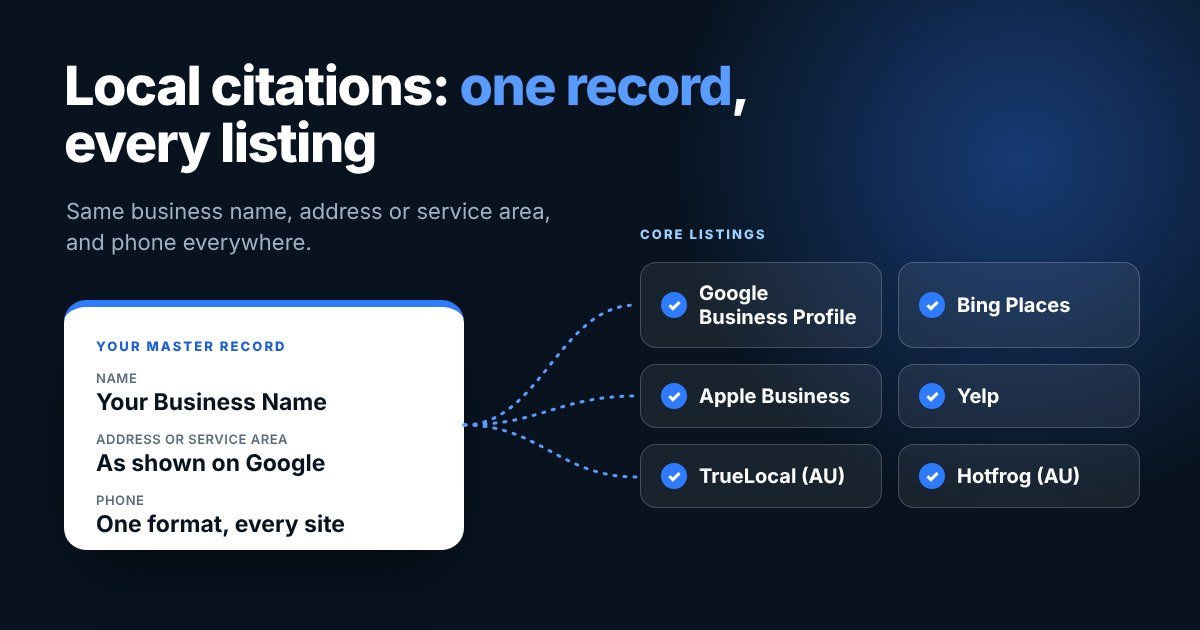
One master record, copied exactly to every core listing.
Local citations are online mentions of your business's name, address and phone number (NAP), usually in directories, maps and apps. They help search engines and customers confirm your business is real and where it works. To build them, set one master NAP record, match it on the core listings below, then fix duplicates and wrong details.
I'm Ryan Malaluan, a CAPM®-certified SEO specialist. I have done hands-on link building and SEO since 2018, at Spacer Technologies, Airtasker, VEED.IO and Fingerprint for Success (Marlee), and I trained off-page SEO teams at Bahagia Staff for six years. I build citations for small businesses in the USA and Australia, and most of the problems I see are not about finding more directories. They are about records that disagree with each other.
The top guides on this topic explain what a citation is and list directories. They say little about two things that decide whether citations work for a real small business: what to do when you have no public address to list, and how to find and fix the wrong listings you already have. This guide covers both, with the core US and Australian sources in one table.
What is a local citation?
A local citation is a mention of your business on a website you don't own. At minimum it shows your business name, address and phone number, which is why people call the set "NAP". Most also include your website, hours, categories and a short description. A mention with only part of that information is called a partial citation.
Citations come in two kinds:
Structured citations are listings in a directory, map or app, where the business details sit in set fields. Examples are your Google Business Profile, a Yelp page or a TrueLocal listing.
Unstructured citations are mentions inside other content: a local news story, a supplier's "find an installer" page, a sponsor list or a chamber of commerce member page. The details are written into the page, not entered in a form.
A citation is not the same as a backlink. A citation confirms who you are and where you work, and it may or may not include a link. A backlink is a link to your site, and its value comes from the authority of the page that gives it. Some citations carry a link, but as I explain in my guide on how many backlinks a small business needs, most directory links add limited link value, so treat citations as a trust and accuracy task first.
Do local citations still help SEO?
They help, but they are a foundation, not a growth lever. Google says local results are based mainly on relevance, distance and prominence. It links prominence to things like how many websites link to your business and how many reviews you have. Its ranking help page does not mention directories or listing counts, and it says there is no way to request or pay for a better local ranking.
So why bother? Three reasons stand up to the evidence:
Google builds profiles from many sources. Its help pages say business information is compiled from public web content, licensed third-party data, user contributions and its own interactions with the business. If other sites carry old or wrong details, they can feed into what Google shows. Google's guidelines also say it can detect category information from mentions of your business across the web.
Customers act on what they find. BrightLocal reports that 63% of consumers say incorrect business information would stop them from choosing a business (BrightLocal's listings research, as cited in its guide to local citations). A wrong phone number on a directory costs a call even if it never moves a ranking.
AI tools read listings too. BrightLocal's 2026 study found that AI tools lean on a set of listing sites such as Yelp, Facebook, Google Business Profile and the Better Business Bureau, though it gives no single figure I can quote. Accurate listings are cheap insurance against an assistant repeating the wrong phone number.
BrightLocal also says the weight of citations as a ranking factor has fluctuated over the years and that they are unlikely to directly drive sales. That matches what I see: citations rarely lift a business on their own, but a business with messy citations is hard to lift at all.
NAP consistency: what has to match
NAP consistency means the same business details appear everywhere, written the same way. Google's guidelines tell you to represent your business as it is consistently known in the real world, to use your real-world business name with no keywords or extra descriptions added, and to keep one profile per business. Apply the same standard to every directory.
Name: use the exact name on your signage, invoices and licence. Not "Smith Roofing Best Roofer Denver" if the business is "Smith Roofing". In Australia, check that it agrees with your registered details on ABN Lookup, the government's free public register of ABN information.
Address: use one format. Decide on "Street" or "St", "Suite" or "Ste", and use it every time. If you hide your address on Google (see the service-area section), don't publish it on a directory instead.
Phone: pick one local number and one format, such as +1 and the area code in the US or +61 in Australia, and keep it identical. If you use a call tracking number on your website, decide which number is your master and use that one consistently on listings.
Website: link to one canonical homepage address, with or without "www" and always with https, matching your site.
Category and description: choose the closest category on each platform and reuse the same short description.
Write the master record in a spreadsheet before you touch a single listing. Every submission is then copy and paste, which removes most typing errors.
Core citation sources for the US and Australia
Start with the platforms customers and search engines already use, then add local and industry sources. This table covers the core sources I check first. I only note a cost where the platform states one on its own pages.
Not a citation. Use it to confirm your registered business name before you create listings.
Licensing board, trade body, chamber of commerce, suppliers
US and AU
Industry and local sources
Often the most relevant citations for a trade, and sometimes a link as well.
A longer list is not a better list. Ten accurate, relevant listings beat fifty copied across directories nobody uses.
Citations for service-area businesses: what to do about your address
This is where most guides stop, and where most tradespeople and home-based consultants get stuck. If you travel to customers and they never visit your premises, Google treats you as a service-area business. Its guidelines say service-area businesses should hide their address from customers and set a service area instead. A business with a staffed storefront and permanent signage can show its address and add service areas.
A few Google rules affect how you fill in citations:
A service-area business gets one profile for the whole area it serves.
You can set up to 20 service areas, made up of cities, postal codes or other areas. You can't define the area as a radius around your location.
A P.O. box or a mailbox at a remote location is not an acceptable address, and a virtual office is not eligible for a profile.
Google says a service area shouldn't extend farther than about two hours of driving time from where the business is based.
Use the same logic on directories. Where a platform lets you hide your street address and list service areas, do that. Where a platform forces you to show an address, don't use a P.O. box or a virtual office to get around it. Either use your real address if you are comfortable with it being public, or skip that platform and put the effort into sources that fit your business. Never show your home address on a directory while hiding it on Google. That mismatch is the NAP inconsistency you are trying to avoid.
Business type
Address on Google
What to enter on citations
Storefront (customers visit, permanent signage)
Show it
The same street address, formatted identically
Hybrid (customers visit and you travel)
Show it and add service areas
The same address, plus service areas where the platform allows
Service-area only (you travel to customers)
Hide it and list service areas
Hide the address where allowed. Match the service areas. Skip platforms that force a public address
For Australian businesses there is one extra check. Keep your trading name in line with your ABN registration, use one phone format (for example, +61 or the same area-code format every time), and list the suburbs or regions you serve consistently across Google, Bing and the Australian directories. I cover this approach in my work on SEO for Australian businesses.
How to build and clean up your citations, step by step
This is the order I follow, because auditing first stops you from creating more duplicates.
Write the master record. Name, address or service area, phone, website, categories, a 50-word description and your hours, in one spreadsheet.
Audit what exists. Search Google and Bing for your business name, your phone number in each format, and your old addresses or names. Note every listing you find, with the URL and whether it is correct.
Fix the big three first. Make Google Business Profile, Bing Places and Apple Business correct. Google says there should be only one profile per business, so merge or remove duplicates through the platform rather than creating new ones.
Claim and correct the rest. For each wrong listing, claim it where the platform lets you and update it. Where a listing can't be claimed, use the platform's report or edit process.
Add the remaining core sources. Work through the table above, then add your licensing board, trade body and chamber of commerce.
Look for unstructured mentions. Check supplier and manufacturer pages, sponsorships, local news and community pages. If your name or number is wrong there, ask for a correction. If you're missing, a polite request often works.
Keep a log. Record the platform, login owner, URL, date and what was entered. When you move, change a phone number or rebrand, you will know every place to update.
Recheck on a schedule. Directories copy each other and customers suggest edits. A quarterly look at your top listings catches drift early.
Use a business email address you control for every account, not a personal address of one team member, so access doesn't disappear when staff change.
Citations by trade: where contractors should start
The core sources are the same for every business, but the extras differ by trade. A roofer, electrician or pest control firm should add its state licensing board, relevant trade association and manufacturer certification pages, because those sites carry trust that a generic directory can't. A builder may also have project and supplier mentions. A cleaning business is nearly always service-area only, so the address rules above apply. For the full trade-by-trade checklist, see my guide to SEO for contractors.
How to tell whether citations are working
Don't judge citations by rank alone. Check three things each month:
Accuracy: your core listings still match the master record.
Google Business Profile performance: calls, website clicks and direction requests.
Leads by source: how many enquiries mention a directory, Apple Maps or Bing, and what customers say when you ask how they found you.
If listings are correct and calls are flat, the constraint is usually elsewhere: reviews, service pages or links. Citations clear the path, they don't walk it for you.
Common local citation mistakes
Adding keywords or a city to the business name on listings.
Publishing a home address on directories while hiding it on Google.
Using a P.O. box or virtual office as a workaround for a public address.
Creating a new listing for a business that already has one, instead of claiming it.
Using several phone numbers or formats for the same business.
Letting a former employee's email own the accounts.
Paying for bulk submissions without checking who will own the listings afterwards.
Building dozens of listings on sites that no customers use.
Getting help with citations
You can do the master record, the audit and the core listings yourself in a few focused sessions. Where owners usually get stuck is the cleanup of old duplicates, the unstructured mentions that need outreach, and keeping the records current while running jobs. That is the part my link building service covers, including the citation work that supports it, with every placement reported.
A local citation is an online mention of your business's name, address and phone number on a site you don't own, such as a directory, map, app or local news page. Some also include your website, hours and categories.
Do local citations help SEO?
They support it. Google's local results are mainly based on relevance, distance and prominence, and Google says business information is compiled from many web sources, so accurate listings reduce the risk of wrong details showing. They rarely lift rankings on their own.
What is NAP consistency?
NAP consistency means your business name, address and phone number are identical on every site where they appear. Use your real-world business name, one address format and one phone format, and match your Google Business Profile.
How many local citations do I need?
There is no official number. Start with the core listings for your country, add the sources that match your trade and location, and stop when new listings are no longer relevant. Accuracy matters more than volume.
Do I need citations if I hide my address on Google?
Yes, but build them without the street address. Service-area businesses should hide the address on Google and list service areas instead. Use platforms that allow the same setup, and skip those that force a public address.
What are the best citation sites for the US and Australia?
Start with Google Business Profile, then Bing Places and Apple Business where they are available in your country. In the US, add Yelp and the Better Business Bureau. In Australia, add TrueLocal, Hotfrog and Yellow Pages, then your trade and local bodies.